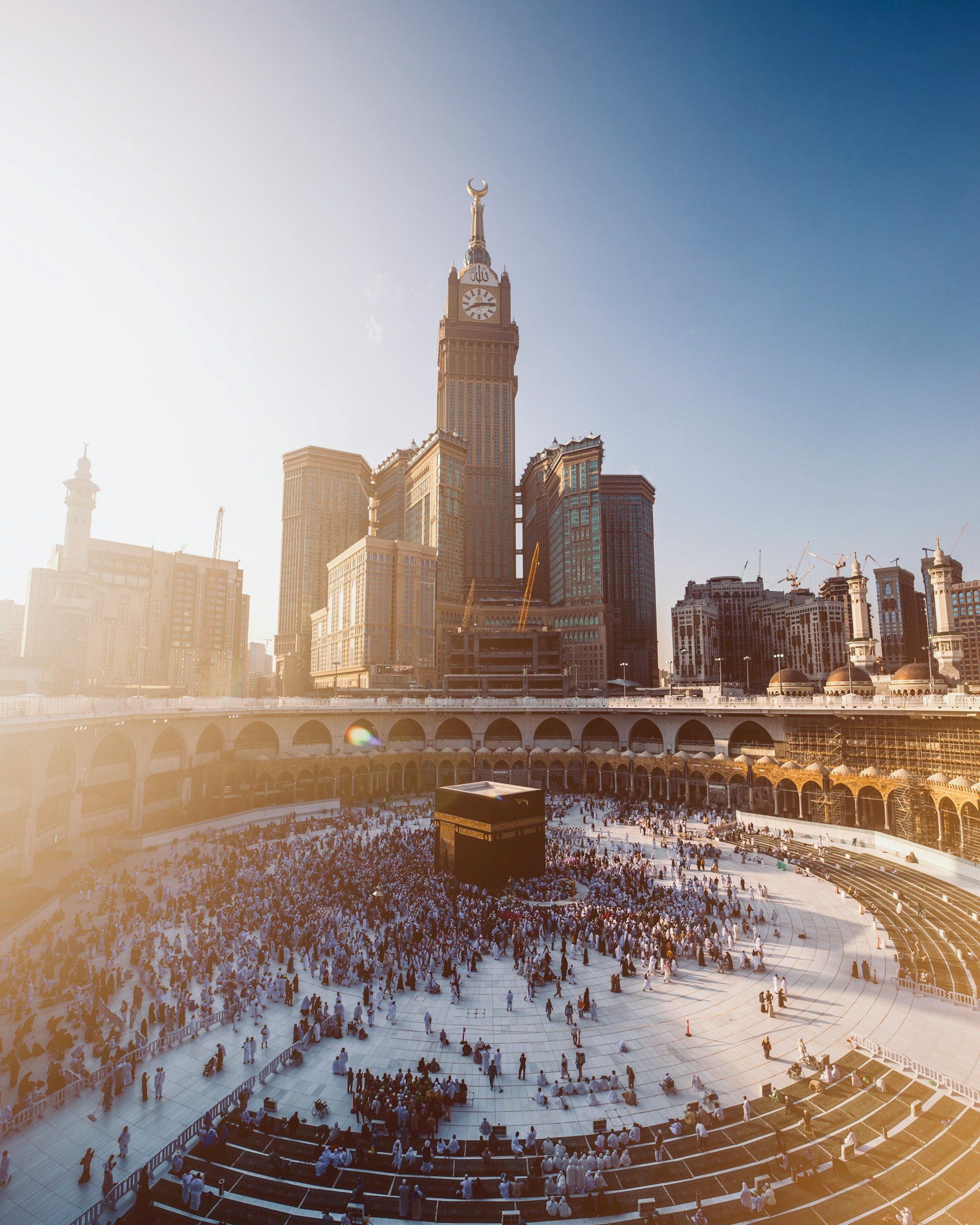
Hajj 2027
Hajj 2027: an early guide for UK pilgrims.
When Hajj falls in 2027, the four UK tier options, what is likely to change, and why the conversation should begin twelve to fifteen months ahead. A guide for British pilgrims preparing for Hajj 1448 AH.
29 April 2026 · 12 min read
In short
Hajj 1448 AH falls in mid May 2027, with the Day of Arafat on or around 12 May 2027. UK pilgrims travel under the Saudi quota through approved providers, in one of four tiers (Maktab A, B, D, or Azizia Economy). Begin the conversation twelve to fifteen months ahead.
Takeaways
- Hajj 1448 AH is approximately 11 to 16 May 2027, with the Day of Arafat around 12 May 2027.
- UK pilgrims must travel under a Saudi quota and an approved package; independent Hajj remains forbidden.
- Four UK tiers shape the journey: Azizia Economy, Economy Non-Shifting Maktab D, Maktab B, Maktab A.
- Begin the conversation twelve to fifteen months ahead. The earlier you express intent, the better your placement.
Hajj is set by the moon. The Hajj of 2027 will fall in mid May, when the heat in Makkah is rising but not yet at its summer peak, and the day of Arafat will be on a Wednesday in the second week of the month. UK pilgrims who plan to travel will book in 2026, prepare across the autumn and winter, and travel in May 2027.
This is what to know now, with thirteen months still to plan well.
When Hajj falls in 2027
Hajj 1448 AH, the Hajj year corresponding to most of 2027 in the Gregorian calendar, runs from the 8th to the 13th of Dhul Hijjah. In the Gregorian calendar, this is approximately:
- 8 Dhul Hijjah (Day of Tarwiyah, departure to Mina): Tuesday 11 May 2027
- 9 Dhul Hijjah (Day of Arafat): Wednesday 12 May 2027
- 10 Dhul Hijjah (Eid al-Adha): Thursday 13 May 2027
- 11 to 13 Dhul Hijjah (Days of Tashreeq): Friday 14 to Sunday 16 May 2027
These dates are approximate. The exact dates depend on the moon sighting at the beginning of Dhul Hijjah, announced by the Saudi Supreme Court. Pilgrims travelling under a UK package will fly out roughly seven to fourteen days before the start of Hajj, allowing time for arrival, ihram, the initial Tawaf and Sai (or its delay until after the Hajj days, depending on the form of Hajj chosen), and a period of acclimatisation.
A typical UK Hajj 2027 itinerary will run from the last week of April or the first week of May until the last week of May or the first days of June. Three to four weeks total, with travel days at each end.
For the rites themselves and how Hajj differs from Umrah, see The difference between Hajj and Umrah, explained simply. For the prior year’s guide, see Hajj 2026.
The twelve to fifteen month window
The most reliable way to enter Hajj 2027 calmly is to begin the conversation in spring or summer 2026. The reasoning is practical, not promotional.
Quota fills early. The UK Hajj quota, around twenty five thousand pilgrims, is allocated by the Saudi Ministry of Hajj and Umrah to approved package providers. Each provider has a finite number of places. The closer Maktab tiers fill first, often by autumn 2026. Booking in spring 2027 means accepting whatever is left, which is rarely the closest hotel or the closest Mina tents.
Document timelines need slack. Passport renewal can take six weeks. Biometric photographs, vaccination certificates, financial documentation if requested by the embassy. None of this is rushed work. Beginning early lets each step happen at its own pace, with no thresholds missed.
The fitness window is real. For most travellers, Hajj is the most physically demanding journey of their lives. Six months of consistent walking, working up to seven to ten kilometres in a single day in heat where possible, prepares the body for the Mashaaer in May. Pilgrims who begin training in March 2027 with two months to spare arrive at Mina exhausted on day one.
The heart needs time. Tawbah is not finished in a week. Asking forgiveness from family, settling debts, completing zakat, writing or updating a will, increasing prayer habits, learning the rites in detail. These are quiet, deep movements. The pilgrim who begins them a year ahead arrives in Madinah already settled.
For more on the visa types and the Nusuk process, see Saudi visa rules by passport: a 2026 guide.
The four UK tiers
UK pilgrims book Hajj as part of a complete package, in one of four tiers. The tiers are not different rites. The Hajj is the same Hajj. What differs is the geography of the journey, especially during the days in Mina, and the proximity of the hotels in Makkah.
Azizia Economy
The most affordable shape. The pilgrim stays in a hotel in the Aziziyah district of Makkah, between the city centre and Mina. During the days of Hajj, the pilgrim commutes daily from Aziziyah to the Mashaaer rather than staying in a Mina tent. The walk from Aziziyah to the entrance of Mina can be one to two kilometres each way, daily.
Suits: physically able pilgrims, those willing to trade Mina-tent presence for the comfort of a hotel room each night, those with budget constraints.
Economy Non-Shifting Maktab D
The pilgrim has a Mina tent in Maktab D, the furthest of the major Mina zones from Jamaraat. Walking distance from tent to Jamaraat can be three to five kilometres each way for the days of stoning. The hotel in Makkah is non-shifting, meaning the pilgrim returns to the same hotel before and after Hajj rather than moving rooms.
Suits: pilgrims who want the Mina tent experience but accept the longer walks, those who value the same Makkah hotel throughout.
Maktab B
A measured middle. Mina tents in Maktab B, around one to two kilometres from Jamaraat. Hotel in Makkah at a closer distance to the Haram than the Economy tier. Walking demands are moderate.
Suits: most middle-aged pilgrims, those balancing comfort and access, families with older children.
Maktab A
The closest tents to Jamaraat, often within five hundred metres. The shortest walks during the days of Hajj. Premium hotels in Makkah and Madinah, typically the closest of the partner properties. Smaller groups, more concierge attention.
Suits: older travellers, those with mobility considerations, families with very young children or elders, those who can afford the tier and want the calmest Hajj.
For a deeper walk through what each tier actually means in physical terms, see How to choose between Hajj tiers: Maktab A, B, D explained.
What is likely to change between 2026 and 2027
A few patterns we expect, based on Saudi Hajj policy direction over recent years.
Continued use of the Nusuk Hajj platform. The app remains the central system for registration, visa issuance, Mashaaer schedules, and Mina bus passes. Expect refinements to the user interface, possibly more integrated payments.
Tighter timing on visa issuance. Saudi Arabia has been issuing Hajj visas closer to departure in recent years, sometimes only a few weeks before. This trend may continue. Independent flight bookings are not advised; the package handles the timing risk.
Possible quota adjustments. The UK quota of around twenty five thousand has shifted slightly year on year. Saudi Arabia periodically adjusts country quotas based on Hajj capacity expansion projects. We pass on confirmed numbers as they are released.
Continued mandatory packages. Independent Hajj from outside the GCC remains forbidden. All international pilgrims travel as part of an approved package.
Heat planning. Hajj 2027 in mid May is somewhat cooler than 2026 in late May, but the heat is still substantial. Daytime temperatures in Makkah can reach forty degrees Celsius. Saudi authorities continue to expand shade and cooling at the Mashaaer.
Visa and vaccination timeline
For Hajj 2027, the timeline of preparation runs roughly:
- Spring 2026: Open the conversation. Confirm tier preference and travelling party.
- Summer to autumn 2026: Reservation deposit. Begin physical preparation. Update passport if needed.
- Late 2026: Provider files quota allocation with Saudi Ministry of Hajj and Umrah.
- Early 2027: Final documents requested. Vaccination kit issued.
- January to March 2027: Vaccinations administered, including meningitis ACWY.
- March to April 2027: Visa application filed by the provider.
- April to early May 2027: Visa issued. Pre-departure briefings.
- Late April to May 2027: Travel.
- Late May to early June 2027: Return.
The meningitis ACWY vaccine is mandatory for all Hajj pilgrims, with the certificate dated at least ten days before arrival and within three years. Influenza and COVID-19 vaccines remain recommended. We share the current requirement list with you in conversation.
Why 2027 might suit you specifically
Some practical observations on whether 2027 is the right year for an individual pilgrim.
Your finances are arranged. Hajj is a substantial undertaking. Pilgrims travelling on borrowed money or under financial strain often regret the timing. The Qur’an conditions Hajj on istita’ah, capacity. If 2027 means dipping into emergency reserves, 2028 or 2029 is calmer.
Your health is sound. If any chronic condition is unstable in 2026, defer until 2028. Hajj rewards the well prepared body.
Your family is settled. Pilgrims with very young infants typically defer until the child is at least two. Pilgrims with elder relatives needing care arrange replacement care for the three to four week absence well in advance.
You can take the time off. Three to four weeks. Longer if you add the visa-to-departure margin. UK employers are generally accommodating but the leave needs to be requested early.
Your intentions are clear. The journey is for the sake of Allah, not for the photograph or the social proof. If the niyyah needs work, give yourself the time to do it.
For pilgrims with mobility considerations or older travellers, Tips for elderly and disabled pilgrims walks through the practical accommodations in detail.
Begin the conversation
Hajj is a commitment shaped over months, not a transaction completed in one call. The first conversation we have with you is unhurried. We listen first, propose later, and walk with you through the entire preparation.
For Hajj 2027, the window is open. For Hajj 2028, opening the conversation now is also welcome. Many pilgrims hold a place for one Hajj while quietly considering the next.
Send us a message on WhatsApp. The first reply usually arrives within the hour during UK business hours. We hold every detail before, during, and after.
For more on the four UK Hajj tiers and the structure of our journeys, see our Hajj page.
Questions, answered
Common questions on this subject.
-
What are the exact dates of Hajj 2027?
Hajj 2027 (1448 AH) is expected to fall on 11 to 16 May 2027 in the Gregorian calendar, with the Day of Arafat (9 Dhul Hijjah) on or around Wednesday 12 May 2027. Final dates are confirmed by Saudi Arabia after the moon sighting at the start of Dhul Hijjah; we share confirmed dates in writing once they are official.
-
When should I begin preparing for Hajj 2027?
Twelve to fifteen months ahead is the standard window. For Hajj 2027 that means opening the conversation between February and May 2026. Earlier is calmer. The best tiers and closest hotels fill first.
-
Why can I not book Hajj independently?
Saudi Arabia has not permitted independent Hajj from the United Kingdom since 2022. All UK pilgrims must travel through an approved provider with a confirmed quota allocation, as a complete package including visa, accommodation, transport, and Mina services.
-
What is likely to change between Hajj 2026 and Hajj 2027?
We expect continued use of the Nusuk app, possibly tighter timing on visa issuance, refinements to the Mashaaer transport system, and small increases in pilgrim quota. The fundamentals of the rite, the dates, and the tier structure are unchanged.
-
How are the four UK tiers different?
Tier difference is mostly about Maktab placement (the Mina zone) and hotel proximity in Makkah. Maktab A is closest to Jamaraat with the shortest walks. Azizia Economy puts the pilgrim in a hotel outside Mina, with daily commutes. We walk through each in [How to choose between Hajj tiers](/journal/hajj-tiers-explained).
-
Is Hajj 2027 the right year for me?
If your circumstances are stable, your finances are arranged, your health is sound, and you can take three to four weeks off, 2027 is a good year. If any of those is not yet settled, beginning the 2028 conversation is the calmer choice.
Continue reading
Other entries from the journal.
Hajj 2026
Hajj 2026: dates, quotas, and what UK pilgrims need to know.
When Hajj falls this year, how UK quotas work, what's changed in the visa process, and how early to begin the conversation. A guide for British pilgrims preparing for Hajj 1447 AH.
Visas
Saudi visa rules by passport: a 2026 guide.
The classic Umrah visa, the Saudi tourist eVisa, the EVW for British passport holders. What each is for, who qualifies, and how to choose, in 2026.
Hajj tiers
How to choose between Hajj tiers: Maktab A, B, D explained.
What each Maktab actually means in physical terms. Tent distance from Jamaraat, walking time, accessibility, hotel proximity. An honest read on what each tier costs, in physical demand rather than money.