Hajj 2026
Hajj 2026: dates, quotas, and what UK pilgrims need to know.
When Hajj falls this year, how UK quotas work, what's changed in the visa process, and how early to begin the conversation. A guide for British pilgrims preparing for Hajj 1447 AH.
20 April 2026 · 12 min read
In short
Hajj 1447 AH falls in late May to early June 2026, with the Day of Arafat on or around 26 May. UK pilgrims travel under the Saudi Hajj quota system, with mandatory packages booked through approved providers. Begin the conversation twelve to fifteen months in advance for the smoothest preparation.
Takeaways
- Hajj 1447 AH is approximately 25 to 30 May 2026, with the Day of Arafat around 26 May.
- UK pilgrims travel under a Saudi quota and must use an approved package; independent travel is not permitted.
- Hajj visa applications open about six months before, through the Nusuk app, and close in early spring.
- Twelve to fifteen months ahead is the standard preparation window. Begin earlier where possible.
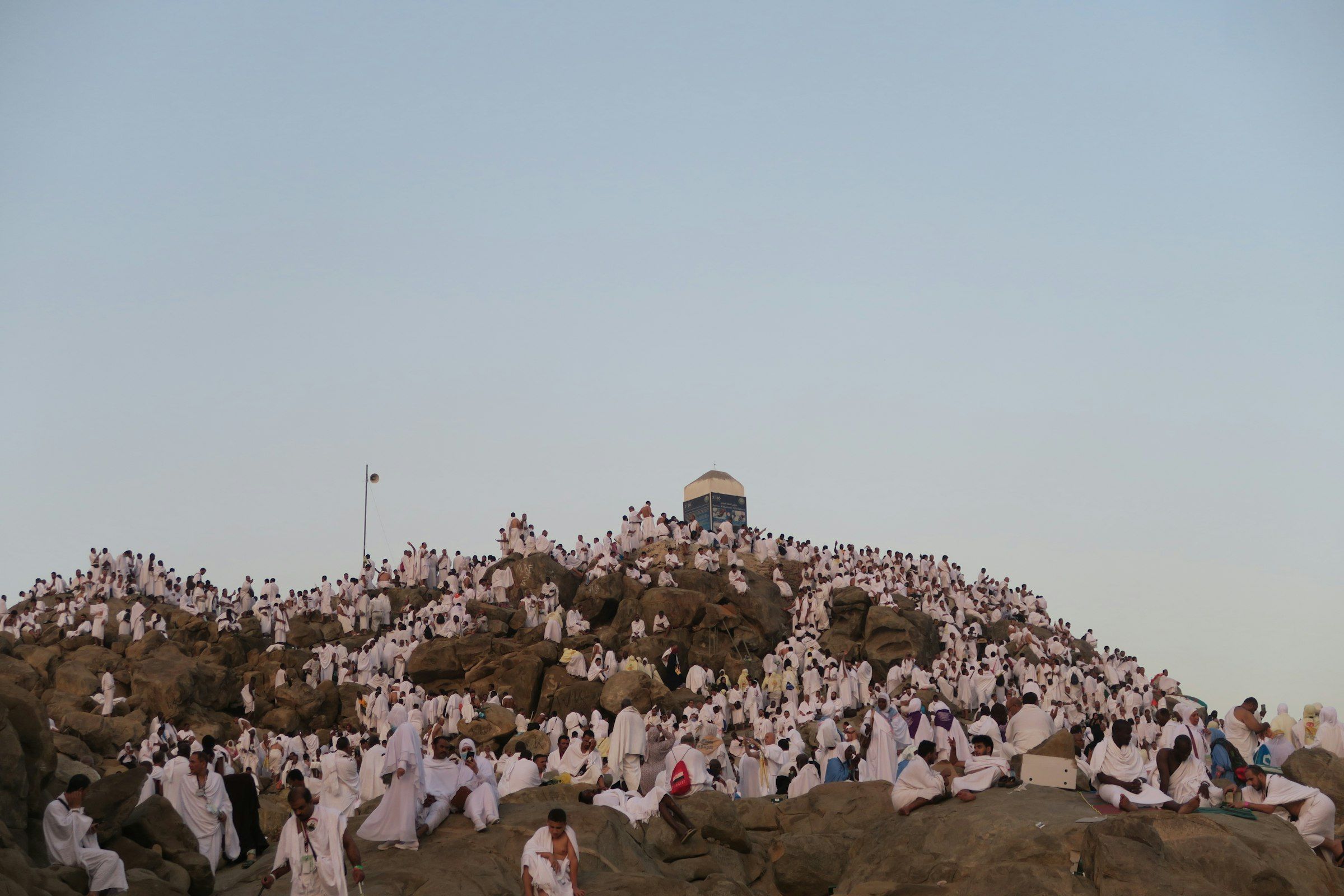
Hajj does not bend to the calendar of the United Kingdom. The Day of Arafat is set by the moon, and the moon is set by something older still. Pilgrims who travel for Hajj 2026 will travel in the last week of May and the first days of June, in the heat of late spring in Makkah, with the city full and the Haram as it always is on those days, gathered into one body.
This is what UK pilgrims should know about that journey, and how to begin preparing for it well.
When Hajj falls in 2026
Hajj 1447 AH, the Hajj year corresponding to most of 2026 in the Gregorian calendar, runs from the 8th to the 13th of Dhul Hijjah. In the Gregorian calendar, this is approximately:
- 8 Dhul Hijjah (Day of Tarwiyah, departure to Mina): Monday 25 May 2026
- 9 Dhul Hijjah (Day of Arafat): Tuesday 26 May 2026
- 10 Dhul Hijjah (Eid al-Adha): Wednesday 27 May 2026
- 11 to 13 Dhul Hijjah (Days of Tashreeq): Thursday 28 to Saturday 30 May 2026
These dates are approximate. The exact dates depend on the moon sighting at the beginning of Dhul Hijjah, announced by the Saudi Supreme Court. Pilgrims travelling under a UK package will fly out roughly 7 to 14 days before the start of Hajj, allowing time for arrival, ihram, the initial Tawaf and Sai (or its delay until after the Hajj days, depending on the form of Hajj chosen), and a period of acclimatisation.
For the rites themselves and how Hajj differs from Umrah, see The difference between Hajj and Umrah, explained simply.
How the UK quota works
Saudi Arabia allocates a country quota for Hajj each year, sized roughly in proportion to each country’s Muslim population. The United Kingdom’s allocation is in the region of 25,000 pilgrims. This number can shift slightly from year to year.
The Saudi Ministry of Hajj and Umrah distributes the UK quota through a list of approved package providers. Each provider receives an allocation that they then offer to pilgrims as complete packages. Independent Hajj from the UK is no longer permitted; pilgrims must book through one of these approved providers.
Double Six Tours, as a sub-agent of ATOL No. 9775, places UK pilgrims with our licensed booking partner who holds an approved Hajj allocation. The visa application is then filed on the pilgrim’s behalf by the partner, through the Nusuk Hajj platform.
What the package includes
A UK Hajj package is more than a visa and a hotel. It includes:
- The Hajj visa itself
- A round trip flight, usually direct from London to Jeddah or Madinah
- Hotels in Madinah (typically four to seven nights, before or after Hajj)
- Hotels in Aziziyah or Makkah for the days surrounding Hajj
- Mina tents under the chosen Maktab tier (A, B, C, or D)
- All transport between Makkah, Mina, Muzdalifah, and Arafat
- Group ziyarat in both cities
- Pre departure briefings, often online and in person
- A guide on the ground, usually Arabic and English speaking
- Meals during the Hajj days in Mina (the rest of the trip is breakfast at the hotel)
The Maktab tier determines proximity of your Mina tents to Jamaraat (where the stoning takes place). Maktab A is closest, with shorter walks. Maktab D is furthest, with longer walks. The price differential between tiers is substantial, as is the comfort.
For a fuller view of the tier shape and what each implies for your days, see our Hajj page.
What’s changed for Hajj 2026
A few practical updates from previous years:
The Nusuk Hajj platform. Saudi Arabia has rolled out the Nusuk app as the central system for Hajj registration, visa issuance, and on the ground services. Pilgrims download it before travel and use it for everything from Mina bus passes to Mashaaer schedules.
Mandatory packages. Independent Hajj from outside the GCC is not permitted. All international pilgrims must travel as part of an approved package.
Tighter timing on visa issuance. Saudi Arabia has been issuing Hajj visas closer to departure in recent years, sometimes only a few weeks before. This makes flight bookings nervier than they used to be. We recommend not booking flights independently; the package handles the timing risk for you.
Updated health requirements. Meningitis ACWY remains mandatory. Influenza and COVID vaccines are recommended. We share the current requirement list with pilgrims as part of preparation.
Heat advisory. With Hajj falling in late May and early June for the next several years, daytime temperatures in Makkah can exceed 45°C. Saudi authorities have expanded shade and cooling at the Mashaaer, but pilgrims need to plan for the heat. Hydration, light cotton clothing under ihram, and rest during the hottest hours of the day are essential.
For details on the visa types and the Nusuk process, see Saudi visa rules by passport: a 2026 guide.
When to begin preparing
Twelve to fifteen months ahead of departure is the standard preparation window. For 2026 Hajj, that means conversations should have begun in spring 2025 for the calmest path. For 2027 Hajj, begin now.
Some travellers expect that they can decide on Hajj a few months before departure. In rare cases, a cancellation makes this possible, but the practical answer is that the quota fills early and good tiers fill earlier. The Maktab A tier with closer hotels usually closes by the previous autumn.
Beginning early gives you:
- Time to gather documents. Passport renewal, biometric photographs, Hajj vaccination certificates, financial documentation if requested.
- Time to consult. If you have health considerations, dietary needs, or are travelling with elderly relatives, the conversation can be paced and considered.
- Time to save. For most UK pilgrims, Hajj is a substantial financial undertaking.
- Time to learn the rites. The classes and books and conversations.
- Time to settle the heart. Hajj is, after all, an act of worship. The preparation of the heart is more important than the suitcase.
Health and physical readiness
Hajj is the most physically demanding journey most pilgrims will undertake. The walks between hotel and Haram in Makkah, the Tawaf in dense crowds, the multi kilometre trips to Jamaraat, the day of standing at Arafat in the heat, the night at Muzdalifah, the lack of sleep, the lack of privacy. None of this is incidental.
Six months out, begin walking. Build up to seven to ten kilometres in a day, in heat where possible. The fitter you arrive, the more present you can be at the rites.
If you have health conditions, share them in the first conversation. Diabetes, hypertension, mobility issues, dialysis, oxygen support, recent surgery. We arrange ground floor rooms, accessible transport, wheelchair Tawaf, medical support on the ground, and where appropriate, a badal (proxy) for the rites that cannot be performed in person.
For pilgrims with mobility considerations, Tips for elderly and disabled pilgrims walks through the practical accommodations in detail.
Financial preparation
Hajj is a significant financial commitment. We do not publish prices on this site (see Why we never put a price on a journey), but the practical guidance is:
Save deliberately. If Hajj is on your horizon, open a dedicated savings account and contribute monthly. The deposit is due upon booking, with the balance staged over the months leading to departure.
Pay from halal sources. The Prophet ﷺ said that Allah is Tayyib, pure, and accepts only what is pure. Pay debts before Hajj where possible. Consult a knowledgeable scholar on questions of mortgaged property, inherited wealth, or business income.
Make wasiyyah (will). Many pilgrims write or update their will before Hajj. This is a sunnah practice, particularly before any significant journey.
Ask forgiveness. Speak to family, friends, and anyone you may have wronged. Settle accounts before you go. The Prophet ﷺ taught that no one should travel for Hajj or Umrah with grievances unresolved.
Spiritual readiness
This is the part that no checklist captures.
Renew tawbah. Sincere repentance, with intention not to return.
Settle worship habits. Establish the five daily prayers if you have not. Begin the night prayer (tahajjud) in the months leading up. Read the Qur’an daily, even if briefly.
Learn the rites. Read the small books on Hajj and Umrah. Watch the videos from reliable scholars. Talk to pilgrims who have been recently. The fitter your knowledge, the calmer your days.
Cultivate sabr. Hajj will test patience. The crowds, the heat, the lost luggage, the mistaken hotel assignment, the friend who falls ill, the bus that is late. The Prophet ﷺ said as-sabru diya’, patience is a light. The pilgrims who arrive with rehearsed sabr have the most peaceful Hajj.
Begin the conversation
Hajj is not a transaction. It is a commitment that is shaped over months. The first conversation we have with you is unhurried. We listen first, propose later, and walk with you through the entire preparation.
For Hajj 2026, the window is closing. For Hajj 2027 and beyond, the window is open.
Send us a message on WhatsApp. The first reply usually arrives within the hour during UK business hours. We hold every detail before, during, and after.
For more on the four UK Hajj tiers (Azizia Economy, Economy Non-Shifting Maktab D, Maktab B, Maktab A), see our Hajj page.
Questions, answered
Common questions on this subject.
-
What are the exact dates of Hajj 2026?
Hajj 2026 (1447 AH) is expected to fall on 25 to 30 May 2026 in the Gregorian calendar, with the Day of Arafat (9 Dhul Hijjah) on or around Tuesday 26 May. Final dates are confirmed by Saudi Arabia after the moon sighting at the start of Dhul Hijjah; we share confirmed dates in writing once they are official.
-
How does the UK Hajj quota work?
Saudi Arabia allocates a country quota to the United Kingdom each year, currently around 25,000 pilgrims. The Saudi Ministry of Hajj and Umrah distributes this through approved UK package providers. Pilgrims book through one of these providers, who then file the visa application on the pilgrim's behalf.
-
Can I do Hajj independently from the UK in 2026?
No. Saudi Arabia has not permitted independent UK Hajj since 2022. All UK pilgrims must travel through an approved provider with a confirmed quota allocation, as a complete package including visa, accommodation, transport, and Mina services.
-
When do Hajj applications open and close?
Hajj applications typically open six to seven months before Hajj (so November or December for the following year's Hajj). They close in February or March, once the country quota is filled. We recommend opening the conversation by the previous summer to secure your tier.
-
What if I cannot get a place in 2026?
Begin early conversations for 2027. Some 2026 cancellations release spaces in the final months but cannot be relied on. The earlier you express intent, the better your placement in subsequent years.
-
Do I need vaccinations for Hajj?
Yes. The meningitis ACWY vaccine is mandatory for all Hajj pilgrims, with the certificate dated at least ten days before arrival and within three years. Influenza and COVID 19 vaccines are recommended. We coordinate the timing in your preparation kit.
-
Is Hajj suitable for elderly or disabled travellers?
Hajj is physically demanding but accommodations are made for elderly and disabled pilgrims. We arrange ground floor rooms, wheelchair access in Mina, and assisted Tawaf at appropriate floors. See our guide on [tips for elderly and disabled pilgrims](/journal/elderly-disabled-pilgrims).
Continue reading
Other entries from the journal.
Comparison
The difference between Hajj and Umrah, explained simply.
Hajj is the obligatory pilgrimage performed once in a lifetime in specific days of the Islamic calendar. Umrah is voluntary, performable any time of the year. The rites overlap, but the obligations differ.
Visas
Saudi visa rules by passport: a 2026 guide.
The classic Umrah visa, the Saudi tourist eVisa, the EVW for British passport holders. What each is for, who qualifies, and how to choose, in 2026.
Accessibility
Tips for elderly and disabled pilgrims.
A compassionate, practical guide for elderly and disabled pilgrims and the families who travel with them. Mobility, hotel selection, the rites for those who cannot perform them physically.