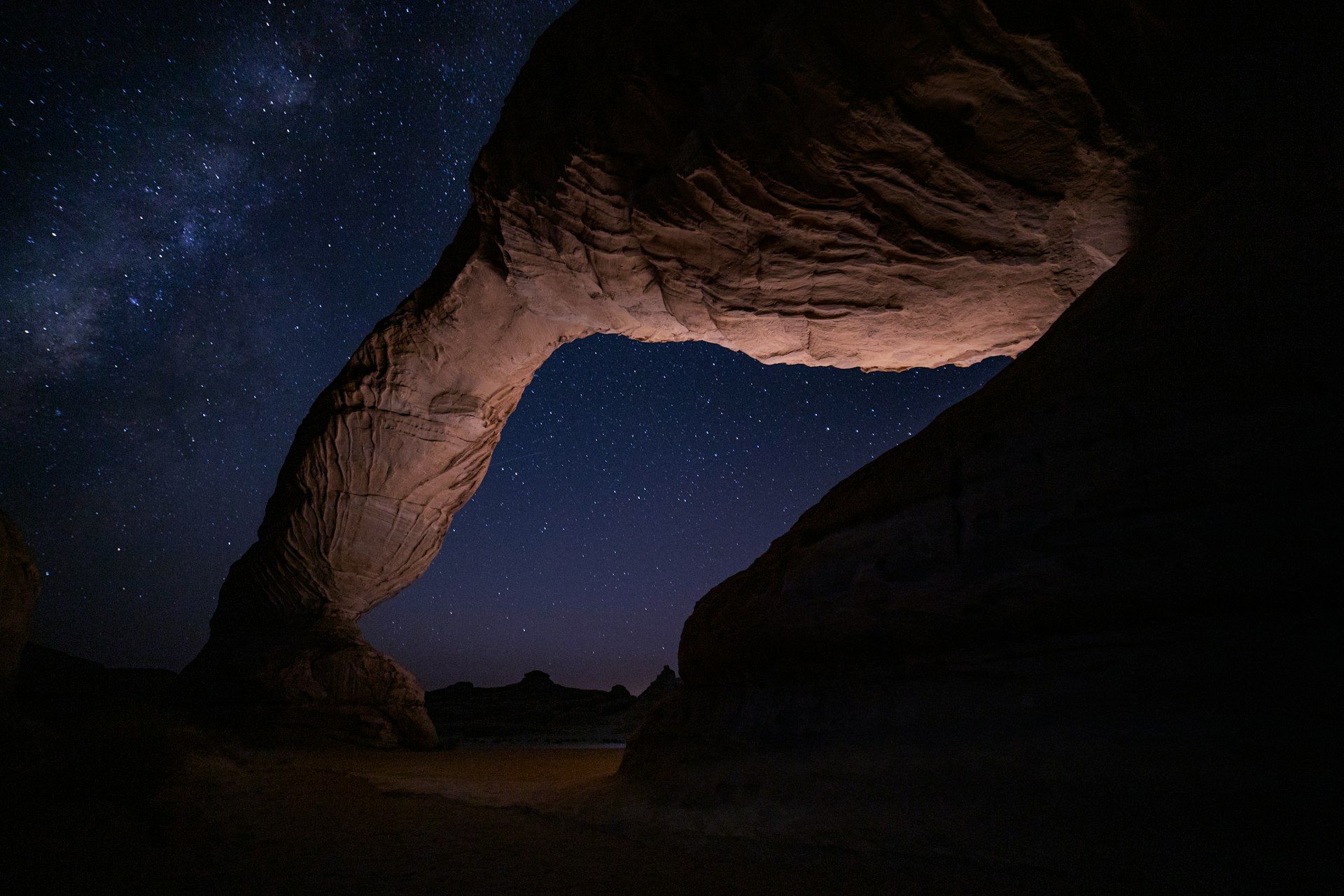
AlUla
Saudi Arabia opens AlUla: a side trip from Madinah.
Three hours from Madinah, the rock-carved Nabataean tombs of Hegra rise from the desert. The Quran calls this the land of Thamud. A reverent guide to visiting a place described as a site of divine punishment.
26 April 2026 · 12 min read
In short
AlUla, three hours from Madinah, holds Hegra (Madain Saleh), a Nabataean city of rock-carved tombs and the Quran's land of Thamud. Saudi Arabia has opened the area to permitted visitors. The Prophet ﷺ guided believers to pass with reflection rather than entertainment. Visit with that frame and a one to two night extension fits naturally with an Umrah journey.
Takeaways
- AlUla is three hours by car from Madinah, on a paved highway through desert.
- Hegra (Madain Saleh) holds 110 Nabataean rock-cut tombs from the first and second centuries CE.
- The Quran refers to this as Al-Hijr, the land of Thamud, who rejected the prophet Sayyiduna Saleh (alayhi salam).
- The Prophet ﷺ instructed companions to pass quickly, weeping, not treating the area as entertainment.
- Permits are required, available via the AlUla visitor portal. Best combined as a one to two night extension on an Umrah journey.
There are places in the Muslim world that the Quran names. Most are named with honour: Madinah, Makkah, the valleys of Mina and Arafat, the rock that the Prophet Ibrahim (alayhi salam) stood on. A smaller number are named differently. Al-Hijr, the rocky northern land, is named as a warning. The Quran says of the people who lived there: the dwellers of al-Hijr denied the messengers, so We sent them Our signs, but they turned away.
For most of Islamic history, this place was a site of avoidance. The Prophet ﷺ, passing the area on the way to Tabuk, covered his face, rode quickly, and instructed his companions not to drink the water of its wells. The hadiths are clear, even if the rulings on visiting today are debated.
In recent years Saudi Arabia has opened the area, now called AlUla, to permitted visitors. The rock-carved tombs of the Nabataean people stand in the desert, untouched by time, more than a hundred of them. The opening has drawn pilgrims, scholars, and questions. This article walks through the questions before the practical details, because the questions matter more.
What the Quran says about Al-Hijr
The people of al-Hijr, called Thamud in the Quran, were the people of the prophet Sayyiduna Saleh (alayhi salam). They were a stone-carving civilisation in the northern Arabian Peninsula, contemporaneous with Lihyan and Nabataea. The Quran tells their story across multiple suras: Al-A’raf 7:73-79, Hud 11:61-68, Al-Hijr 15:80-84, Ash-Shu’ara 26:141-159, An-Naml 27:45-53, Fussilat 41:17-18, Al-Qamar 54:23-32, and Al-Hijr is named directly in Surah Al-Hijr 15:80.
Sayyiduna Saleh (alayhi salam) was sent to call them to the worship of one God. They demanded a sign. He brought forth a she-camel from the rock, with the instruction that she would drink from the well one day, and the people the next, and that they should not harm her. They harmed her. The punishment came as a great cry, and the houses they had carved were left empty.
The Quran says: they used to carve houses out of the mountains, feeling secure. But the cry overtook them in the morning, and what they had earned availed them not (Al-Hijr 15:82-84).
The houses they carved are the tombs visible today. The rock-cut facades of Hegra are the architectural style of those people, refined further by the Nabataeans who came later, then preserved by the dry desert for two thousand years.
The Prophetic guidance on visiting
Two hadith collections preserve the Prophet’s ﷺ instructions to his companions when they passed the area on the campaign to Tabuk in 9 AH. The substance of the guidance:
-
Do not enter the dwellings of those who wronged themselves except weeping, lest the same affliction reach you. The companions covered their faces, hurried past, and did not linger.
-
Do not drink from the water of their wells. The Prophet ﷺ instructed them not to drink the water, not to perform wudu with it, and not to use it for cooking. The dough they had already mixed with the water, he said, should be fed to their camels.
-
He covered his face. The Prophet ﷺ pulled the cloak over his face as the caravan moved through, and he urged the camel to move quickly.
These hadiths shape how Muslim scholars have read the visiting question for fourteen centuries. The classical position, articulated in the major schools of thought, is that visits to such places should be avoided unless one is genuinely passing through, and even then with the spirit of i’tibar — taking lessons, weeping, reflecting on the fragility of the seemingly secure.
How to think about the visit
Saudi Arabia’s tourism opening at AlUla has placed contemporary scholars in a new position. Some have written on the question.
The conservative view, articulated by some Saudi scholars, holds that visits remain discouraged or impermissible, regardless of the modern infrastructure. The reasoning: the guidance of the Prophet ﷺ was not about the wells or the buildings of that specific moment, but about the nature of the place itself.
The permitted-with-conditions view, held by other scholars, allows visits when the visitor’s intention is reflection rather than entertainment. The visitor approaches the site with weeping, with awareness of what happened there, with the reading of the relevant Quranic verses, and with the awareness that what afflicted that people could afflict any people who turn from God. The visit becomes a kind of educational ziyarat, like visiting Uhud, but with the caveat that the dead of al-Hijr are the punished, not the martyrs.
We do not adjudicate scholarly disagreements. The pilgrim consults a scholar in their school of thought and decides accordingly. What we offer is the journey itself, in either form: avoidance or a reflective visit. For pilgrims who choose to visit, the framing of the visit matters more than the photographs.
For more on the broader landscape of ziyarat, see Top places of ziyarat in Makkah and Madinah.
The Nabataean ruins of Hegra
If you do visit, what you will see is among the more remarkable archaeological landscapes in the world.
Hegra, also called Madain Saleh (the cities of Saleh), holds approximately 110 rock-carved tombs from the first and second centuries CE. The Nabataean people, who also built Petra further north in present-day Jordan, were a trading civilisation whose wealth came from incense and spice routes between southern Arabia and the Mediterranean. Their architectural style — facades carved directly into sandstone outcrops, with detailed friezes and inscribed names — was at its peak in this period.
The tombs are not pyramids and not Petra exactly. They are individual sandstone outcrops, each rising from the desert floor like rock islands, with one or several tombs carved into each face. Qasr al-Farid, the most photographed, is a single tomb in a single rock, never finished, suggesting the carving was interrupted by the death of the patron. Qasr al-Bint and the Diwan are tomb clusters with multiple chambers. The inscriptions name the original owners, often referring to multiple generations of one family.
UNESCO inscribed Hegra as Saudi Arabia’s first World Heritage Site in 2008, before tourism opened. The site has been studied by archaeologists for over a century, and the recent Saudi conservation work has been done in partnership with international archaeological bodies.
What you see is, materially, remarkable. What it is, theologically, is the architectural style of a people the Quran names. The two are the same stones.
The wider AlUla landscape
Beyond Hegra, the AlUla region holds other sites worth knowing about:
Dadan, the city of the Lihyanite kingdom, predates the Nabataeans. The rock-cut tombs of the Lihyanite kings sit in the cliffs above the modern road to Hegra. Less commonly visited but quietly atmospheric.
Jabal Ikmah, called by some the open library of AlUla, is a narrow canyon where ancient inscriptions in multiple scripts (Dadanitic, Aramaic, Nabataean, Thamudic) are carved into the rock walls. Visited as an educational stop.
Elephant Rock (Jabal AlFil) is a natural sandstone formation that resembles an elephant. A photogenic stop, popular with visitors, less freighted with theological weight.
The AlUla Old Town is an Ottoman-era walled village, abandoned in the 1980s when residents moved to modern housing nearby. Restored in recent years, walkable, with small shops and a quiet evening atmosphere.
The Hijaz Railway station ruins are remnants of the Ottoman-era railway that once ran from Damascus to Madinah. Lawrence of Arabia famously sabotaged the line during the First World War. The station ruins sit at the edge of the modern town.
Getting there and combining with Umrah
By road from Madinah, AlUla is approximately three hours on the paved highway. The drive itself is a long desert road, flat and quiet, with rest stops along the way. We arrange the transfer with a local partner.
By air, there is a regional airport in AlUla (with flights from Riyadh, Jeddah, and seasonally from international destinations). For most travellers, the road from Madinah is simpler.
Permits are required for entry to Hegra and the other archaeological sites. Tickets are time-slotted, booked through the AlUla visitor portal (experiencealula.com or the Nusuk app). We coordinate the bookings in advance.
Accommodation in AlUla ranges from modest hotels in the modern town to high-end resorts in the surrounding desert. We typically book a mid-range hotel for one to two nights.
Combining with an Umrah journey: the most common pattern is to add the AlUla visit between Madinah and Makkah. The pilgrim arrives in Madinah, completes the Madinah portion of the Umrah journey (visits to the Prophet’s Mosque ﷺ, the Rawdah, ziyarat to Quba and Uhud), then drives north to AlUla for one to two nights, then returns through Madinah and proceeds to Makkah for the rites of Umrah.
For pilgrims who prefer to keep AlUla separate from the Umrah, the visit can also be made on a return flight via Madinah, with the Umrah completed first.
For more on the day to day shape of an Umrah journey including ziyarat, see A day by day Umrah itinerary. For the visa structure, see Saudi visa rules by passport: a 2026 guide.
A closing reflection
The Quran tells us why this place is named in the Book. The Prophet ﷺ tells us how to pass through it. Together they form the lens.
If you visit, visit slowly. Read the Quranic verses on Thamud beforehand. Walk among the tombs in silence. Do not pose for cheerful photographs. Do not treat the place as a backdrop. Receive the lesson the place was preserved to give: that all civilisations, however magnificent the buildings they raise, end. That the heart that turns from God is the heart that loses the favour. That the only safety is in submission.
The Prophet ﷺ wept passing here. The pilgrim who wishes to visit may, with the right intention, weep too. That is the visit the place was preserved to receive.
To begin a quiet conversation about extending an Umrah journey to include AlUla, send us a message on WhatsApp. For the structure of our Umrah journeys including the option to extend to AlUla, see the dedicated page.
Questions, answered
Common questions on this subject.
-
Is it permissible to visit AlUla as a Muslim?
Scholarly opinions vary. The classical view, derived from the Prophet's ﷺ guidance to his companions when passing the area, is that visits should be made with reflection (i'tibar), not entertainment, and ideally not at all unless one is passing through. Some contemporary scholars permit visits with the right intention; others discourage even brief visits. Consult a knowledgeable scholar in your school of thought.
-
What did the Prophet ﷺ say about Al-Hijr?
Passing through the area on the way to Tabuk, the Prophet ﷺ told his companions not to enter the dwellings of those who wronged themselves except with weeping, lest what afflicted them afflict the believer. He instructed them not to drink the water of the wells of Thamud, except for ablution, and to feed the dough they had prepared with that water to their camels. He covered his face and rode quickly through the area.
-
How do I get to AlUla from Madinah?
By private car, about three hours on the paved highway through the desert. By bus, around four hours. Some travellers fly from Madinah to AlUla airport, around an hour, but this is unnecessary for most. We arrange the road transfer with our local partner.
-
What permits do I need?
Saudi Arabia requires advance booking through the AlUla visitor portal (experiencealula.com or the Nusuk app). Tickets are issued for specific time slots and specific sites within the area. Some sites require guided tours, which we arrange in advance.
-
What is there to see beyond Hegra?
Beyond the Nabataean tombs at Hegra: Elephant Rock (a striking natural rock formation), Dadan (the older Lihyanite kingdom site), Jabal Ikmah (ancient inscriptions in multiple scripts), the AlUla Old Town (an Ottoman-era walled village), and the Hijaz Railway station ruins. Two days covers the major sites at a calm pace.
-
Can I combine AlUla with my Umrah journey?
Yes. Most pilgrims who visit do so as a one to two night extension after Madinah and before Makkah, or after Makkah on the way home. We coordinate the timing and the permits in advance. Add three to five days to the standard Umrah itinerary.
-
Is it safe?
Yes. AlUla is a well-managed Saudi tourism area with clear infrastructure, paved roads, modern hotels, and medical facilities. Standard travel precautions apply. Heat is the main practical concern; visit between October and April for moderate temperatures.
Continue reading
Other entries from the journal.
Itinerary
A day by day Umrah itinerary.
A practical ten night Umrah template, five nights in Madinah and five in Makkah. Each day described with morning, afternoon, and evening structure. Reverent and practical.
Ziyarat
Top places of ziyarat in Makkah and Madinah.
Beyond the Haram itself, the cities of Madinah and Makkah hold places that the Prophet ﷺ walked, prayed, and rested. A reverent guide to the major sites and the etiquette of visiting.
Visas
Saudi visa rules by passport: a 2026 guide.
The classic Umrah visa, the Saudi tourist eVisa, the EVW for British passport holders. What each is for, who qualifies, and how to choose, in 2026.