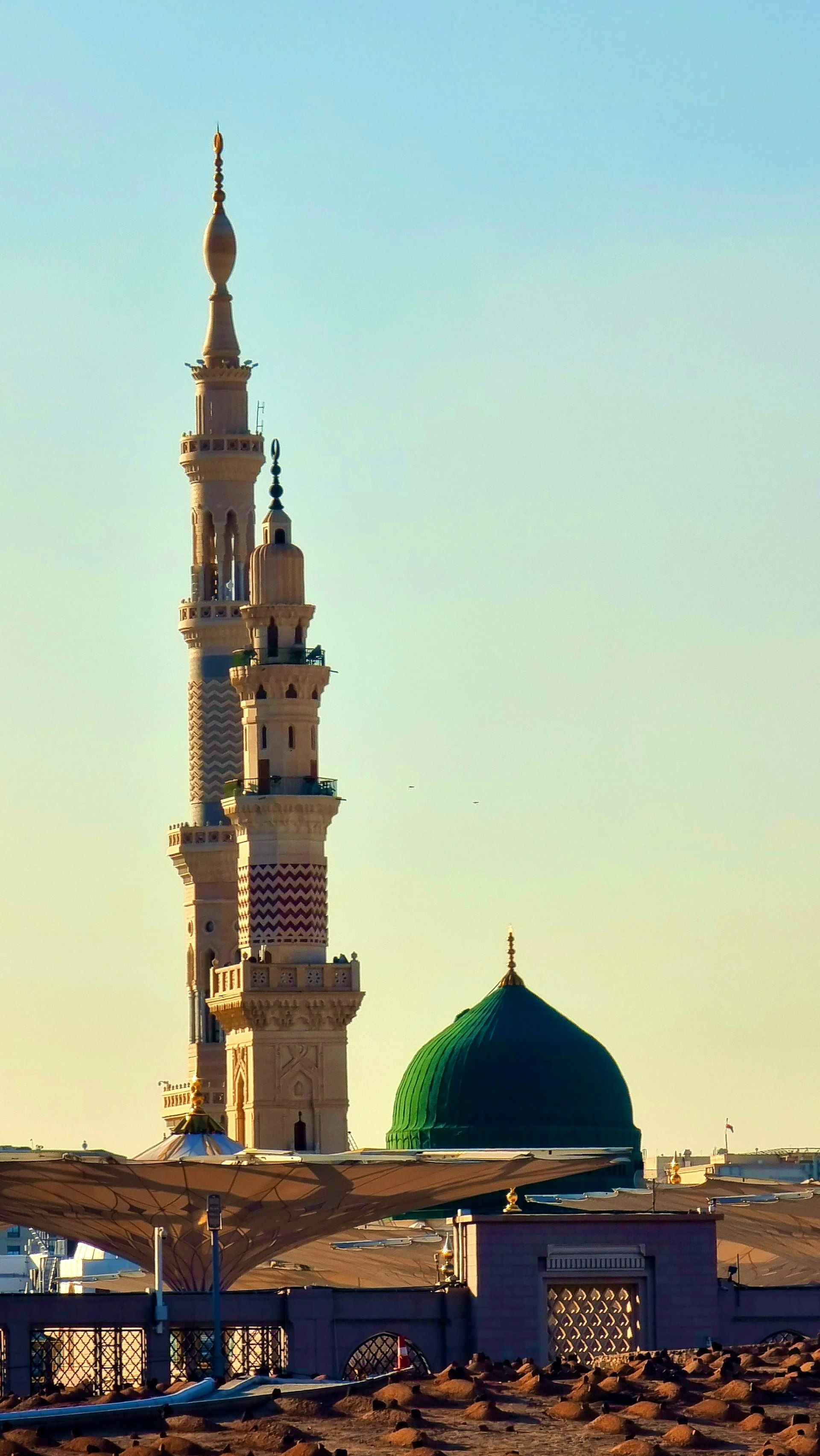
Ziyarat
Top places of ziyarat in Makkah and Madinah.
Beyond the Haram itself, the cities of Madinah and Makkah hold places that the Prophet ﷺ walked, prayed, and rested. A reverent guide to the major sites and the etiquette of visiting.
14 April 2026 · 12 min read
In short
In Madinah: Masjid an Nabawi (the Prophet's Mosque ﷺ), the Rawdah, Quba (the first mosque), Uhud (the battlefield), Baqi (the cemetery), and Qiblatayn. In Makkah: Mina, Arafat, Muzdalifah (during Hajj), the Cave of Hira on Jabal an Nour, the Cave of Thawr, and Jannat al Mu'alla. Each carries its own etiquette.
Takeaways
- Madinah's primary ziyarat: the Prophet's Mosque ﷺ, the Rawdah, Quba, Uhud, Baqi, and Qiblatayn.
- Makkah's primary ziyarat: the Mashaaer (Mina, Arafat, Muzdalifah), Jabal an Nour (Cave of Hira), Jabal Thawr, and Jannat al Mu'alla.
- Etiquette matters. Ziyarat is for remembrance and du'a, not photography or grave veneration. Quiet conduct is expected at every site.
- A guide who knows the lesser known maqamat is worth the additional cost. The cities hold more than the famous sites.
The cities of Madinah and Makkah are full of places where the Prophet ﷺ walked, prayed, fought, suffered, and was given victory. The Tawaf and the Sai are the formal rites; the visits beyond them are the heart of the journey. To pray in the Quba mosque, to walk the slope of Uhud, to enter the Cave of Hira where the first revelation was given, is to walk through the Prophetic biography in real space, not in books.
This is a guide to those visits, gently walked, with the etiquette that the places ask for.
Madinah: the city of the Prophet ﷺ
Madinah is approached gently. The Prophet ﷺ called it Tayyibah (the good) and al-Madinah al-Munawwarah (the radiant). On entering, the traveller traditionally pauses to recite the words of arrival, sends salutations on the Prophet ﷺ, and proceeds with calm.
Masjid an Nabawi, the Prophet’s Mosque ﷺ
The Prophet’s Mosque ﷺ is the second holiest mosque in Islam, after the Sacred Mosque in Makkah. The Prophet ﷺ said that one prayer in my mosque is better than a thousand prayers in any other mosque, except for Masjid al-Haram. Pilgrims aim to pray as many of the daily prayers in the mosque as possible.
The mosque has multiple entrances, each named after a companion or a feature. Bab as Salam is the most commonly used entry by visitors, on the western side. Bab Jibril is on the eastern side, near the Prophet’s ﷺ burial chamber. Bab al Baqi leads out toward the cemetery.
On first entering, two rakats of tahiyyat al-masjid are prayed. Sit, rest, and absorb the space.
The Rawdah
The Rawdah is the small area between the mihrab (where the Prophet ﷺ led prayer) and his minbar (the pulpit from which he spoke). The Prophet ﷺ said that between my house and my pulpit is a garden of the gardens of paradise. The carpet of the Rawdah is green, marking the space.
Saudi authorities now manage Rawdah entry through the Nusuk app, with timed permits. Visitors are admitted in batches, typically with thirty minutes inside. Two rakats are prayed. Du’a is made. The space is left without rush, but without lingering once du’a is complete; others are waiting.
The etiquette inside the Rawdah is firm: quiet, no photography in the burial chamber direction, no pushing. The pilgrims who come most quietly receive the most.
The Prophet’s burial chamber and the salam
Adjacent to the Rawdah is the Hujrah, the burial chamber, where the Prophet ﷺ rests alongside Abu Bakr and Umar (radiyAllahu anhuma). Visitors approach the gold lattice screen, stop, and offer the salam.
The standard form is:
As salamu alayka ya Rasulallah, wa rahmatullahi wa barakatuh.
Then a step to the right, and the salam to Abu Bakr. Then another step, and the salam to Umar. The visitor does not linger, does not touch the lattice, does not perform tawaf around the chamber (this is impermissible). The salam is given, and the visitor moves on.
Quba, the first mosque
A short distance south of the city centre is Masjid Quba, the first mosque built in Islam. The Prophet ﷺ stopped here on his hijrah and laid the foundations himself. He used to visit Quba every Saturday for the rest of his life.
He said: Whoever purifies themselves at home, then comes to Masjid Quba and prays therein, has the reward of an Umrah.
For this reason, many travellers make an early morning visit to Quba on at least one day of their stay in Madinah. Two rakats inside, with intention and humility, carries the reward of an Umrah.
Uhud, the mountain and the battlefield
A short drive from the city, the rising form of Mount Uhud marks the site of the second major battle in Islamic history. Seventy companions of the Prophet ﷺ were martyred here, including his uncle Sayyiduna Hamzah (radiyAllahu anhu), the Lion of Allah.
A small visitors’ area marks the graves of the martyrs. Visitors offer the salam and make du’a for them. The Prophet ﷺ used to visit Uhud each year to greet the martyrs.
The Prophet ﷺ said of Uhud itself: It is a mountain that loves us, and we love it. The mountain is climbed by some pilgrims; many simply stand at its base and remember.
Baqi, the cemetery
Jannat al-Baqi, the Garden of Baqi, lies adjacent to the Prophet’s Mosque on its eastern side. It is the cemetery in which most of the Prophet’s family ﷺ, many of the Sahaba, and the great early generations are buried.
Buried here, among others: Fatimah al-Zahra, Hasan ibn Ali, Uthman ibn Affan, the wives of the Prophet ﷺ (with the exception of Khadijah, in Makkah), and many others (radiyAllahu anhum).
Visitors enter, offer the salam to the people of the graves, and make du’a for them. The standard greeting is:
As salamu alaykum ya ahla al-quboor, yaghfir Allahu lana wa lakum.
Saudi authorities have, in recent years, opened Baqi to women’s visiting on a defined schedule. Consult your guide.
Masjid Qiblatayn
The Mosque of the Two Qiblas. Here, during a single congregational prayer, the verse came down ordering the change of qibla from Jerusalem to Makkah. The companions, mid prayer, turned together. The mosque retains both directions architecturally.
A short visit, two rakats, and a moment to consider what it meant for those who had been praying toward Jerusalem all their lives.
Makkah: the Mother of Cities
The visits in Makkah are different in shape from Madinah. The Sacred Mosque is the centre, and the city around it is sparser of formal ziyarat sites than Madinah. The famous places are mostly outside the city itself, in the Mashaaer (the sites of the Hajj rites).
The Sacred Mosque
The first and last visit, every day. Pilgrims pray as many of the daily prayers in the Haram as possible. One prayer in this mosque is better than one hundred thousand in any other.
Beyond the Tawaf, sit. The Haram offers something to those who simply remain. Du’a, dhikr, Qur’an, and the hours of presence in the place where prayer is multiplied.
For more on the rites of Umrah at the Haram, see Umrah for first time pilgrims.
Mina, Muzdalifah, and Arafat
These are the Mashaaer, the appointed places of the Hajj rites. Pilgrims travelling outside Hajj season often take a day trip to walk the route: Mina with its tents, Muzdalifah with its open ground, Arafat with the Mount of Mercy. The plain of Arafat is where the Prophet ﷺ delivered his Farewell Sermon. Standing there, even outside the Hajj days, is a deep moment.
Jabal an Nour, the Cave of Hira
A short drive from central Makkah, Jabal an-Nour, the Mountain of Light, holds the Cave of Hira at its peak. This is the cave in which the Prophet ﷺ used to retreat in seclusion before his prophethood, and in which the angel Jibril (alayhi salam) came to him with the first verses: Iqra bismi Rabbika alladhi khalaq.
The climb to the cave is steep, about an hour for fit travellers. Many older pilgrims view the mountain from below and stand in remembrance without making the climb. Both visits are permissible, neither is required.
Jabal Thawr
The Mountain of Thawr lies south of Makkah. The Cave of Thawr is where the Prophet ﷺ and Sayyiduna Abu Bakr (radiyAllahu anhu) hid for three nights during the hijrah, while the people of Quraysh searched for them. The verse was revealed: When the two of them were in the cave, when he said to his companion, ‘Do not grieve, surely Allah is with us’.
The climb to the cave is even steeper than Hira. Many pilgrims do not climb. The Quranic verse is enough.
Jannat al-Mu’alla
The cemetery of Makkah, on the northern edge of the city. Many of the Prophet’s family ﷺ are buried here, including Sayyidatuna Khadijah (radiyAllahu anha), the first to believe, and Sayyiduna Abdullah, the Prophet’s ﷺ son who died in infancy.
Visitors offer the salam, make du’a, and depart quietly.
The birthplace and other lesser sites
The Prophet’s birthplace ﷺ in central Makkah has been preserved as a small library. The places where the early Sahaba prayed, the locations of the early lessons given by the Prophet ﷺ, are scattered through the city. A guide who knows the city points to them along the way.
On etiquette
A few principles apply at every site:
Quiet. Whisper, do not raise the voice, do not shout to friends across the courtyard.
Photography. Cameras are widely tolerated but should never be pointed at the burial chamber, the green dome of the Prophet’s Mosque ﷺ, or in directions that disrupt others’ worship. The phone in the pocket is the better choice for most of these visits.
No grave veneration. Visitors come to greet, supplicate, and remember. Tawaf around graves is impermissible. Touching the lattice screens for blessings is discouraged.
Move on. Many places are crowded. Once you have prayed and made du’a, move so others can take your place. The visit is shaped by giving space.
Receive the place. The pilgrim who sits quietly at Quba for fifteen minutes will leave changed. The pilgrim who photographs the entry, prays in haste, and tweets from the courtyard will have only photographs.
In closing
The cities of Madinah and Makkah hold more than the Tawaf and the Sai. They hold the geography of the Prophetic life, in real ground that you can stand on. Walking the small distances between these places is itself a kind of dhikr. The Prophet ﷺ walked these same slopes, breathed the same dust, prayed in the same direction.
A good guide makes the difference. The cities reveal themselves to those who know what to point to.
For the day to day rhythm of an Umrah journey including ziyarat, see A day by day Umrah itinerary. For the structure of our Umrah journeys including ziyarat in both cities, see the dedicated page.
To begin a quiet conversation, send us a message on WhatsApp.
Questions, answered
Common questions on this subject.
-
Is ziyarat compulsory during Umrah?
No. The rites of Umrah are confined to Makkah (Tawaf, Sai, halq). Visiting Madinah and the surrounding sites is sunnah, deeply recommended, and customary, but not part of the rite itself. Most Umrah journeys include three to seven nights in Madinah.
-
How long should I spend in Madinah?
Three to seven nights is typical. The Prophet ﷺ encouraged staying long enough to pray forty consecutive prayers in the Prophet's Mosque, which takes about eight days. Travellers with less time still benefit immensely from shorter stays.
-
Can I visit the Rawdah whenever I want?
The Rawdah is now managed by a permit system through the Nusuk app, with timed entries to manage crowd. Permits are typically issued for specific time slots. We arrange these slots in advance for our travellers.
-
Is it permissible to ask the Prophet ﷺ to intercede for me?
The orthodox understanding is to send salutations and salawat upon the Prophet ﷺ, and to make du'a directly to Allah, asking by means of the Prophet's status with Him. The specifics of tawassul and intercession are discussed by scholars; we recommend consulting a knowledgeable scholar in your school of thought.
-
Are women allowed to visit Baqi and Uhud?
Visiting the cemeteries by women is a matter of scholarly difference. The Hanbali school traditionally restricted women from visiting graves; many other scholars permit it for the purpose of remembrance and supplication. Saudi authorities currently permit women to visit Uhud freely. Baqi access for women has varied; consult your guide.
-
What is the etiquette inside the Prophet's Mosque?
Speak quietly. Do not point cameras toward the green dome or the burial chamber. Do not push toward the Rawdah. Recite quietly. Make du'a privately. Receive the experience without performing it.
Continue reading
Other entries from the journal.
Itinerary
A day by day Umrah itinerary.
A practical ten night Umrah template, five nights in Madinah and five in Makkah. Each day described with morning, afternoon, and evening structure. Reverent and practical.
Preparation
Umrah for first time pilgrims: a quiet preparation.
A literary guide for the first time pilgrim. Spiritual preparation, ihram, the rites step by step, common mistakes, and what to expect emotionally.
Comparison
The difference between Hajj and Umrah, explained simply.
Hajj is the obligatory pilgrimage performed once in a lifetime in specific days of the Islamic calendar. Umrah is voluntary, performable any time of the year. The rites overlap, but the obligations differ.