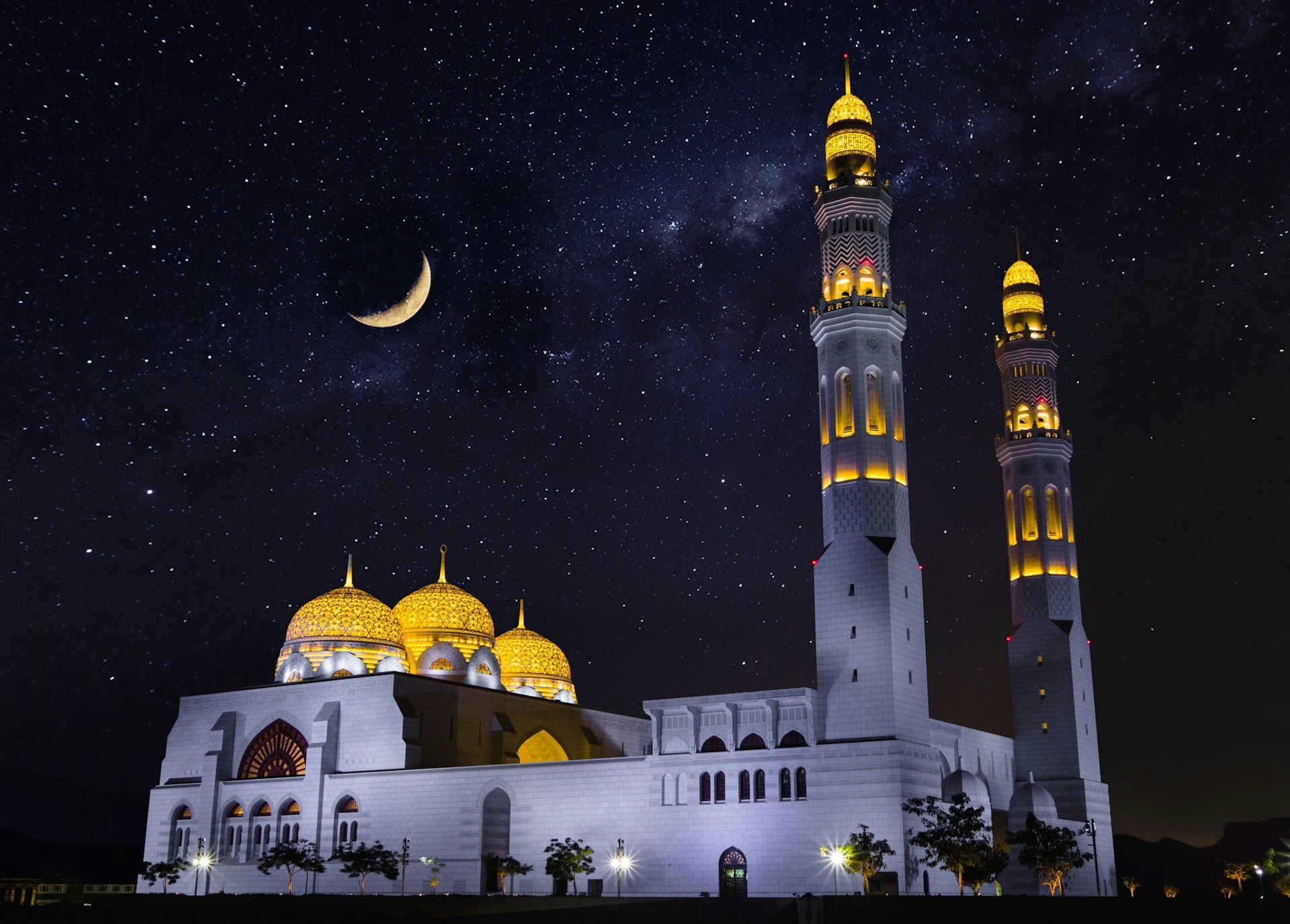
Ramadan
Umrah during Ramadan: what makes the last ten nights different.
The spiritual weight of the last ten nights, the search for Laylat al-Qadr, the crowd density, and the practical rhythm of fasting in Madinah and Makkah. A reverent guide.
28 April 2026 · 12 min read
In short
Umrah in Ramadan equals Hajj in reward, per a hadith of the Prophet ﷺ. The last ten nights, with Laylat al-Qadr hidden among the odd nights, are the most spiritually charged of the year. Crowds are at their densest, prices peak, and booking twelve months ahead is the minimum for any tier.
Takeaways
- The Prophet ﷺ said an Umrah in Ramadan equals a Hajj in reward.
- The last ten nights hide Laylat al-Qadr, the night better than a thousand months.
- Crowds are at their densest, prices at their peak, and twelve months ahead is the minimum booking window.
- Ramadan Umrah is suited to those willing to embrace intensity, less suited to first time pilgrims, mobility-limited travellers, or families with very young children.
The Prophet ﷺ said: Umrah in Ramadan equals Hajj in reward. The hadith is short, recorded in the major collections, and has shaped the year for millions of pilgrims who plan their lives around the possibility of being in Makkah for the month of fasting. Among the days of Ramadan, the last ten nights hold the heaviest weight. We sent it down on the Night of Power, and what will make you know what the Night of Power is? The Night of Power is better than a thousand months.
This is what Ramadan Umrah is, walked through gently. The reward, the conditions, the crowd, the rhythm of the fast in Madinah and Makkah, and an honest read on whether this is the right season for your particular journey.
The reward
Some hadiths require careful interpretation. This one is plain. Umrah in Ramadan equals Hajj in reward — the Prophet ﷺ said this to a woman of Madinah, Umm Sinan al-Ansariyyah, who told him she could not perform Hajj that year because the family’s water-carrying camel was needed for cultivation. She had two camels: one her husband had taken for Hajj, and the other for the farm. The Prophet ﷺ told her, instead, to perform Umrah in Ramadan, and her reward would equal Hajj.
The hadith does not mean Umrah replaces the Hajj obligation. The obligation to perform Hajj once in a lifetime remains for those able. But for those who cannot perform Hajj in a given year, or who wish to add a journey of weight to a year that does not contain their Hajj, Umrah in Ramadan is the second journey the Prophet ﷺ named.
For more on the difference between Hajj and Umrah and how the obligations sit, see The difference between Hajj and Umrah, explained simply.
The fast and the journey
Ramadan reshapes the day. The fast begins at Fajr and breaks at Maghrib. In Makkah and Madinah during Ramadan, this is approximately fourteen to fifteen hours, depending on the time of year (Ramadan currently falls in late February to mid March, so daylight is moderate; in past decades when Ramadan fell in summer, fasts were closer to sixteen hours).
The pilgrim’s day in Ramadan is inverted from the typical Umrah rhythm. The hours from Fajr to Maghrib are quieter, conserved for prayer and rest. The hours from Maghrib through Tarawih and into the night are the active hours. Many pilgrims sleep from early morning to midday, eat sehri before Fajr, pray Fajr, then return to sleep through the heat of the day.
This is not the rhythm to learn for the first time during the journey. Pilgrims who have not fasted in a hot climate before should consider an earlier visit, perhaps the first half of Ramadan, before the full intensity of the last ten nights.
The last ten nights
The last ten nights of Ramadan are the spiritual peak of the year. The Prophet ﷺ would, in those nights, tighten his waist-cloth, stay awake the whole night, and rouse his family for prayer. He would not sleep, in the words of one narration. He would seek Laylat al-Qadr, the Night of Power.
Laylat al-Qadr is hidden. The Prophet ﷺ told the companions which night it was, but on the way to tell them, he encountered two arguing men, and the knowledge of the night was lifted from his memory. He said it would be among the odd nights of the last ten: the twenty first, twenty third, twenty fifth, twenty seventh, or twenty ninth night of Ramadan. He told the believers to seek it across all of them.
The reward of one night spent in worship on Laylat al-Qadr is better than a thousand months. The maths translates to roughly eighty three years of continuous worship, in a single night.
For pilgrims in Makkah or Madinah for the last ten nights, the question is not whether to seek the night but how. Most pilgrims aim to spend the entire night, on each odd night at minimum, in the Haram. Some perform itikaf, the practice of secluding oneself in the mosque for the entire ten days, a sunnah of the Prophet ﷺ. The Saudi authorities permit limited itikaf at the Haram with prior registration.
Tarawih and Qiyam at the Haram
Tarawih is the long voluntary night prayer of Ramadan. At the Haram, it is led by some of the most respected reciters of the Qur’an in the Muslim world. The recitation moves through the entire Qur’an across the month, with one juz (one thirtieth of the Qur’an) recited each night.
The Tarawih prayer at the Haram is twenty rakats, performed in two-rakat units, with brief rests between. After Tarawih comes Qiyam, an additional voluntary prayer that begins after midnight and runs until shortly before Fajr. On the last ten nights, Qiyam at the Haram is among the most affecting acts of worship a pilgrim will ever witness.
The recitation is unhurried. The imams pray with a steady, considered pace. The bowing and prostration are long. A single rakat can take twenty minutes. The full Qiyam can run two to three hours.
Many pilgrims who have never wept in prayer find themselves weeping at the Haram during Qiyam in the last ten nights. The sound of the imam, the silence of the crowd, the depth of the night, the awareness of the place. It is, for many, the high point of the entire spiritual life.
The crowds
The last ten nights of Ramadan bring the densest crowds the Haram sees outside Hajj itself. Tawaf at peak hours is shoulder to shoulder. The Sa’i corridor fills. The marble floor of the mosque is taken by Qiyam-praying rows. The courtyards spill into the streets.
What this means in practical terms:
- Tawaf takes longer. What might be forty five minutes in October becomes ninety minutes in late Ramadan.
- Walking to and from the hotel is slow. What might be five minutes becomes twenty.
- Finding a place to sit before Tarawih requires planning. Pilgrims arrive an hour before Maghrib to claim a spot in the front rows.
- The Sa’i corridor closes for some hours. Saudi authorities sometimes restrict Sa’i during peak prayer times to manage flow.
- Bottled water becomes scarce. Stock up earlier in the day.
- Patience becomes the rite. Pilgrims who arrive expecting calm leave frustrated. Pilgrims who arrive expecting density find the crowd is part of the worship itself.
For more on the seasonal differences in crowd density, see The best time of year to perform Umrah.
Iftar and sehri logistics
Iftar at the Haram is one of the unforgettable experiences of Ramadan Umrah. Just before Maghrib, the floor of the mosque fills with simple iftar: dates, water, laban (yoghurt drink), sometimes bread. Volunteers walk the rows distributing these to whoever sits. The pilgrim breaks the fast with the muezzin’s call, prays Maghrib in the mosque, and continues through Isha and Tarawih.
Practical considerations:
- Bring a small prayer mat and a cloth. You will sit on the floor for an extended period.
- Arrive ninety minutes before Maghrib. Sooner during the last ten nights.
- Drink moderately. Pilgrims sometimes overdrink at iftar and feel uncomfortable through Tarawih.
- Eat slowly. Date first, water, prayer. The full meal, if eaten, comes later at the hotel.
Sehri logistics are quieter. Most hotels offer a sehri buffet from 02:00 to 04:00, ending shortly before Fajr. Pilgrims who pray Qiyam at the Haram return to the hotel for sehri, then return to the Haram for Fajr. The cycle: hotel sehri, Haram Fajr, hotel sleep, hotel iftar prep, Haram from Maghrib through Qiyam.
A small refrigerator in the hotel room helps. Many pilgrims keep dates, fruit, and water available for late-night returns.
Booking and preparation
For Ramadan Umrah in the last ten nights, twelve months ahead is the minimum. For the closer hotels (Anjum or Diyar Al Taqwa for Madinah, Emaar Grand Hotel or Anjum for Makkah), eighteen months is more realistic.
The booking shape:
- Year out: Reservation deposit, hotel and flight blocks reserved.
- Six months out: Visa preparation begins. Vaccination scheduled.
- Three months out: Visa issued. Pre-departure briefing.
- One month out: Final balance due. Final preparation of the heart.
For more on the visa rules, see Saudi visa rules by passport: a 2026 guide. For the day to day shape of the journey, see A day by day Umrah itinerary.
Prices peak. We do not publish prices on this site, but the seasonal differential for Ramadan, especially the last ten nights, is substantial.
Who Ramadan Umrah is for
The pilgrim who has fasted Ramadan many times in their home country, who has attended Tarawih regularly, who is willing to embrace the intensity of the crowds, and who has the stamina for inverted day rhythm. For many such pilgrims, Ramadan Umrah is the spiritual peak of their lives.
Pilgrims travelling without children, or with older children comfortable in dense environments. Pilgrims with adequate physical fitness, including the ability to walk in heat with patience. Pilgrims with the financial capacity to absorb the seasonal premium.
Who it is not for
A few honest counterpoints.
First time pilgrims often find the last ten nights overwhelming. The geography of the Haram is unfamiliar. The rhythm of the rites is still being learned. The crowd density adds confusion to what is already a deeply emotional experience. We typically recommend that first time pilgrims travel outside Ramadan or in the first half of Ramadan if they want a Ramadan experience. For first time guidance, see Umrah for first time pilgrims: a quiet preparation.
Mobility-limited travellers can perform Ramadan Umrah but the crowd density makes wheelchair Tawaf significantly slower. Pilgrims with significant mobility considerations may find an autumn or winter journey more peaceful. See Tips for elderly and disabled pilgrims.
Families with very young children often find Ramadan crowds difficult. Strollers in the Haram are cumbersome. Bedtime routines collide with Qiyam timings. The slow pace of feeding and nappy changes does not align with the rhythm of dense rows of worshippers.
Those on a tight budget. The seasonal premium is real. If finances are stretched, the same Umrah outside Ramadan delivers the rites without the crowd or the cost.
In closing
Ramadan in the Haram is among the deepest spiritual experiences available to a Muslim in this lifetime. The last ten nights, with Laylat al-Qadr hidden among them, hold a weight no other nights of the year carry. Pilgrims who travel in those nights often speak of the journey for the rest of their lives.
The journey rewards preparation. Begin early. Plan with patience. Embrace the density. Seek the night.
To begin a quiet conversation about a Ramadan Umrah, send us a message on WhatsApp. For our Umrah journeys across six tiers, see the dedicated page.
Questions, answered
Common questions on this subject.
-
Why does Umrah in Ramadan equal Hajj in reward?
The Prophet ﷺ said this directly, in a hadith reported by Bukhari and Muslim. Umrah in Ramadan does not replace the Hajj obligation; the obligation to perform Hajj once in a lifetime remains. But the reward of an Umrah performed during Ramadan is described by the Prophet ﷺ as equal to the reward of a Hajj.
-
When is Laylat al-Qadr?
Laylat al-Qadr, the Night of Power, is hidden among the last ten nights of Ramadan, specifically among the odd nights (21st, 23rd, 25th, 27th, 29th). The Prophet ﷺ encouraged believers to seek it across all the odd nights rather than fixing on one. Many pilgrims pray throughout all ten.
-
How crowded is the Haram during the last ten nights?
Among the densest crowds the Haram sees outside Hajj itself. Tawaf at peak hours is shoulder to shoulder. Tarawih and Qiyam fill the entire mosque and overflow into the courtyards. Walking from hotel to Haram becomes a slow movement. Plan for this and be patient.
-
How early should I book a Ramadan Umrah?
Twelve months ahead is the minimum we recommend for any tier. For the closer hotels (Anjum, Diyar Al Taqwa, Emaar Royal Hotel) the booking window is often eighteen months. Pilgrims who plan to travel in the last ten nights specifically should treat that as a year-out commitment.
-
What is iftar like at the Haram?
The mosque distributes simple iftar (dates, water, sometimes laban or bread) to whoever sits in the rows shortly before Maghrib. Many pilgrims break their fast there, pray Maghrib, and stay through Isha and Tarawih. The atmosphere is one of shared simplicity. Bring a small mat and patience for the rows filling.
-
Is Ramadan Umrah suitable for first time pilgrims?
It can be, but we generally recommend that first time pilgrims travel outside Ramadan or in the first half of Ramadan if they want a Ramadan experience. The crowd density of the last ten nights is overwhelming for those still learning the geography of the Haram and the rhythm of the rites.
-
Can I extend my Umrah to perform multiple Umrahs during Ramadan?
Yes. Some pilgrims perform Umrah on arrival and again toward the end of Ramadan, exiting and re entering ihram from a miqat such as Tan'eem. The reward of each Umrah in Ramadan is independent. Plan for the additional time and the second ihram entry.
Continue reading
Other entries from the journal.
Planning
The best time of year to perform Umrah.
Ramadan, winter, summer, the in between months. Each season carries a different Umrah. We walk through the differences in crowds, weather, and atmosphere, so you can choose for your circumstance.
Preparation
Umrah for first time pilgrims: a quiet preparation.
A literary guide for the first time pilgrim. Spiritual preparation, ihram, the rites step by step, common mistakes, and what to expect emotionally.
Itinerary
A day by day Umrah itinerary.
A practical ten night Umrah template, five nights in Madinah and five in Makkah. Each day described with morning, afternoon, and evening structure. Reverent and practical.