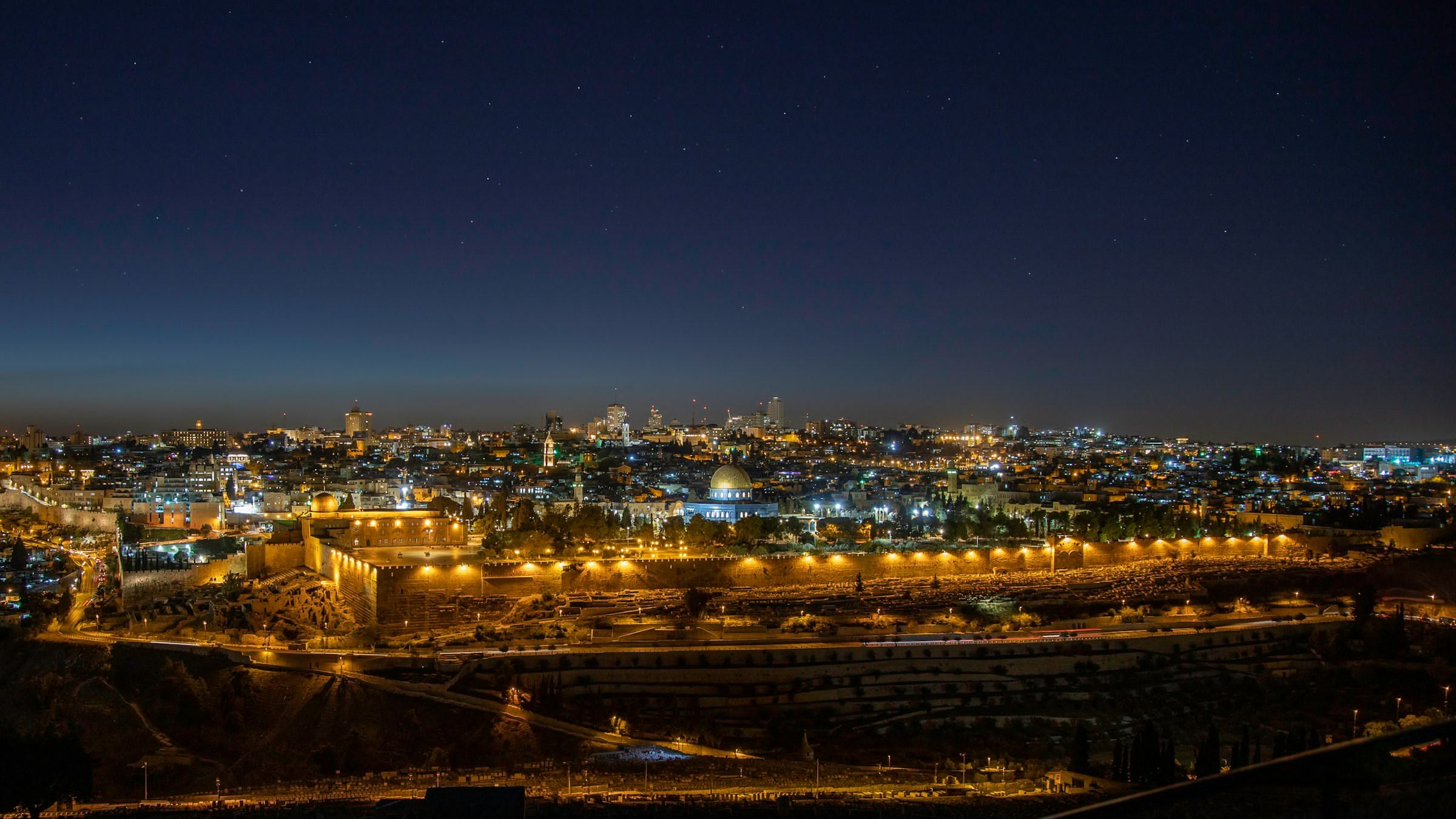
Al Aqsa
Al Aqsa: a visit guide for Jerusalem travellers.
Entering through the Old City gates, Jummah at Al Aqsa, the etiquette inside, side trips to Bethlehem, Hebron, and Jericho. A guide for first time visitors to the Land of the Prophets.
8 April 2026 · 12 min read
In short
Al Aqsa is reached through the Old City of Jerusalem, with Muslim pilgrims entering primarily through Bab Hutta or Bab al Asbat. British passport holders enter Israel without a visa. Plan three Jummahs at Al Aqsa minimum, with side trips to Bethlehem, Hebron, and Jericho. Travel respectfully, with a guide who lives the city.
Takeaways
- British passport holders enter Israel without a visa for short stays. Some travellers prefer the Jordan route.
- Enter the Old City through Damascus Gate (Bab al Amud), then to Al Aqsa via Bab Hutta or Bab al Asbat.
- Three Jummahs at Al Aqsa is the standard goal for a complete journey, alongside daily prayers.
- Side trips: Bethlehem (Masjid Sayyidina Umar), Hebron (Masjid Ibrahimi), Jericho. Each is a half day.
Jerusalem, al-Quds, is approached differently from Madinah and Makkah. The city is older. The history is denser. The path to the Haram is through narrow streets that have not changed in shape for fifteen hundred years. The visitor is one of many who have come, and one of few in the lifetime of any given traveller. The journey rewards a slowness that the modern airport does not invite.
This is a guide for the Muslim traveller making their way to Masjid al-Aqsa, walked through gently, with the practical and the reverent kept side by side.
Why visit
Al-Aqsa is the third holiest site in Islam. The Prophet ﷺ said that travel for prayer is permitted to only three mosques: the Sacred Mosque in Makkah, his own Mosque in Madinah, and Masjid al-Aqsa.
It is also the destination of the Isra, the Night Journey, in which the Prophet ﷺ was carried from Makkah to Jerusalem in a single night, and from there ascended through the heavens. The verse opens Subhanalladhi asra bi’abdihi laylan minal Masjidil Harami ilal Masjidil Aqsa, Glory be to Him who took His servant by night from the Sacred Mosque to the Furthest Mosque.
For thirteen years before the qibla shifted to Makkah, Muslims prayed toward Jerusalem. The first qibla. The mosque of the prophets. Many of the prophets are buried within an hour’s drive of the Haram.
For the broader context of how Al-Aqsa fits with the other journeys, see The difference between Hajj and Umrah, explained simply.
Approach: from Tel Aviv or from Amman
Two main entry routes are available for British and other passport holders:
Via Tel Aviv (Ben Gurion Airport)
Most direct. British passport holders enter Israel without a visa, with an entry permit issued at immigration. Driving from Tel Aviv to Jerusalem is about an hour.
Considerations:
- Israeli immigration questioning can be detailed. Be prepared with a clear reason for travel, hotel reservation, and onward flight.
- The entry stamp is now usually paper (not in the passport), making onward travel to other countries (including Saudi Arabia) easier.
- Direct flights from London to Tel Aviv are frequent.
Via Amman (Queen Alia Airport)
Some travellers prefer to fly to Amman in Jordan and cross overland into the West Bank via the Allenby Bridge (also called the King Hussein Bridge). The crossing can take three to five hours including security.
Considerations:
- The Israeli authorities issue a paper permit at the bridge, not a stamp.
- The drive from Amman to the bridge is about an hour. From the bridge to Jerusalem is another hour.
- This route is preferred by travellers who want to avoid an Israeli stamp in their passport for onward travel to certain Muslim countries.
We confirm the right route in conversation. Both are commonly used.
The Old City and the gates
Jerusalem’s Old City is contained within Ottoman walls built in the sixteenth century. The walls have eight gates, each historically associated with a quarter or a direction. For Muslim pilgrims, the most relevant are:
- Damascus Gate (Bab al-Amud, Sha’ar Shechem in Hebrew): The most beautiful and busiest gate, on the northern side. Most travellers enter the Old City through here.
- Bab Hutta: On the northern wall of the Haram al-Sharif. The closest gate from outside the city to Al-Aqsa for Muslim worshippers.
- Bab al-Asbat (Lions’ Gate): On the eastern wall. Another common entry to the Haram.
- Bab al-Maghariba: On the southwest, used by non Muslim visitors to the Haram complex.
Inside the Old City, the streets are narrow, stepped, and often confusing for first time visitors. A guide who lives the city is invaluable.
Inside the Haram al-Sharif
The Haram al-Sharif (the Noble Sanctuary) is the elevated platform that holds Masjid al-Aqsa and the Dome of the Rock. The compound itself is sacred ground; entering the platform is a form of ziyarat.
The two main buildings:
Masjid al-Aqsa (the Qibli mosque)
The silver domed mosque on the southern side. The main congregational mosque, where the daily and Friday prayers are held. Inside, the marble columns, the wooden minbar, the geometric mihrab. This is the building that gives the compound its name (al-Aqsa meaning the furthest).
Daily prayers are held inside the Qibli mosque. Friday Jummah is held here, often spilling out into the compound when the mosque fills.
Qubbat al-Sakhrah (the Dome of the Rock)
The golden domed shrine in the centre of the compound. It was built by the Umayyad caliph Abd al-Malik in the seventh century, over the rock from which the Prophet ﷺ ascended on the Night Journey. Inside, the rock itself is enclosed by a low wooden fence. Visitors enter, look upon the rock, recite, supplicate, and depart.
The Dome of the Rock is not a congregational mosque but a shrine. It is, however, sometimes used for prayer, particularly when Al-Aqsa is full.
Jummah at Al-Aqsa
The Friday prayer at Al-Aqsa is the most concentrated experience of the journey. Pilgrims aim to arrive early, often by 1100 for a 1300 prayer in summer or a 1230 prayer in winter.
Practical tips:
- Carry your passport. Israeli authorities sometimes restrict access to the Haram for security reasons; access for foreign passport holders is generally smoother than for local Palestinian residents.
- Wudu before entering. The ablution facilities inside the compound are excellent but busy on Fridays.
- Bring a small prayer mat. If the mosque is full, you will pray in the compound.
- Stay after the prayer. The crowd disperses slowly. Many pilgrims spend the next hour reading Qur’an or visiting the Dome of the Rock.
A complete Al-Aqsa journey ideally includes three Friday prayers. Our Al Aqsa journeys are built around this rhythm.
Daily prayers and the wider compound
Beyond Jummah, daily prayers at Al-Aqsa are an essential part of the journey. The five daily prayers each carry their own atmosphere. Fajr is the most peaceful, with the courtyard gradually filling as the dawn advances. Maghrib has the call from the minarets ringing across the city. Isha is gentle, with the Old City quieting around the compound.
Smaller maqamat within the Haram al-Sharif:
- The Marwani Mosque (Solomon’s Stables), an underground space in the southeast.
- The Buraq Wall, on the western side, where the Prophet’s mount ﷺ is said to have been tethered.
- The Mount of Olives, just outside the eastern wall, with views over the entire Old City.
A knowledgeable guide will walk you to each.
Side trips: Bethlehem, Hebron, Jericho
Within ninety minutes of Jerusalem are three other cities of deep significance. Each is a half day visit.
Bethlehem (Bayt Lahm)
About thirty minutes south of Jerusalem. The town is small, with a beautiful old quarter. Sites:
- Masjid Sayyidina Umar, built in the seventh century to commemorate the prayer of Sayyiduna Umar (radiyAllahu anhu) on his entry to the city.
- The Birthplace, the spot in Christian tradition where Sayyiduna Isa (alayhi salam) was born. Open to Muslim visitors.
- The old market quarter.
Hebron (al-Khalil)
About an hour south of Jerusalem. The city of Sayyiduna Ibrahim (alayhi salam), called al-Khalil, the friend (of Allah).
- Masjid Ibrahimi. The mosque built over the cave in which Ibrahim (alayhi salam), Sarah, Ishaq, Rabqa, Ya’qub, and Layah are buried (in Islamic tradition). The structure dates to the time of the Romans and has been a Muslim mosque since the seventh century.
- The interior is divided into a Muslim and a Jewish section since 1994. Foreign Muslim visitors are generally permitted access on most days. Fridays are busy.
Jericho (Ariha)
About forty minutes east of Jerusalem, in the Jordan Valley. One of the oldest continuously inhabited cities in the world.
- Maqam Sayyiduna Musa (Nabi Musa), in the desert outside the town.
- The old city of Ariha.
- The Mount of Temptation in Christian tradition.
A combined Jericho and Dead Sea day is popular.
For our Al Aqsa journeys including all three side trips, see the dedicated page.
Etiquette
A few principles:
Quiet. The Haram al-Sharif is busy and political; many pilgrims walk in a slow silence rather than chatting.
Modesty. Women cover the head before entering Al-Aqsa or the Dome of the Rock. Men wear long trousers and modest tops.
Respect for residents. Many of the homes in the Old City are owned by Palestinian families who have lived there for centuries. Walk gently.
Shoes. Removed before entering Al-Aqsa, the Dome of the Rock, and Masjid Sayyidina Umar in Bethlehem. Bring a small bag for your shoes.
No alcohol or non halal food. The Old City has many halal restaurants, particularly in the Muslim Quarter.
A note on safety
Conditions in Jerusalem can change rapidly. We monitor the situation through local partners and only travel when the way is calm. If we cannot deliver a journey safely, we will not deliver it. The pilgrim’s wellbeing is the first consideration, before the rite.
In closing
Al-Aqsa rewards the patient traveller. The Old City does not give itself quickly. The first Jummah is overwhelming. The third Jummah is when the place begins to know you. By the end of seven nights, the streets become familiar, the call to prayer becomes a clock, and the visitor begins to understand why the Prophets walked here.
To begin a quiet conversation, send us a message on WhatsApp. For our Al Aqsa journeys across three tiers of comfort, see the dedicated page.
Questions, answered
Common questions on this subject.
-
Is travel to Al Aqsa safe in 2026?
Conditions in Jerusalem fluctuate. We monitor the situation closely with our local partners and travel only when the way is calm. We share current advice during conversation. The Old City itself, when reachable, is generally calm and welcoming to Muslim pilgrims.
-
Do I need a visa for Israel as a British passport holder?
British passport holders do not require a visa for short stays in Israel (up to ninety days). On arrival, an entry stamp or paper visa is issued. Some travellers prefer to enter via Jordan and cross at the Allenby Bridge to avoid an Israeli stamp; we walk through the choice.
-
Can I pray Jummah at Al Aqsa?
Yes. Jummah is the busiest and most spiritually intense prayer at Al Aqsa. We arrive early (often by 1100 for a 1300 prayer in summer) and find a place inside. The Friday khutbah is in Arabic. The atmosphere is unforgettable.
-
What is the difference between Al Aqsa and the Dome of the Rock?
Both are within the Haram al Sharif compound. Masjid al Aqsa is the silver domed mosque on the southern side, the third holiest site in Islam. The Dome of the Rock (Qubbat al Sakhrah) is the golden domed shrine in the centre, built over the rock from which the Prophet ﷺ ascended on the Night Journey. Both are sacred. Both are visited.
-
How long should I spend in Jerusalem?
Seven nights is a complete first visit, allowing three Jummahs, daily prayers at Al Aqsa, and side trips to Bethlehem, Hebron, and Jericho. Ten to twelve nights is more comfortable. Less than five nights misses the depth.
-
What about Bethlehem and Hebron?
Both are reachable as half day trips from Jerusalem. Bethlehem hosts Masjid Sayyidina Umar and the birthplace tradition of Sayyiduna Isa (alayhi salam). Hebron hosts Masjid Ibrahimi, where Sayyiduna Ibrahim (alayhi salam), Sayyidatuna Sarah, Sayyiduna Ishaq, and others are buried (in Islamic tradition). Both are essential to the journey.
Continue reading
Other entries from the journal.
Visas
Saudi visa rules by passport: a 2026 guide.
The classic Umrah visa, the Saudi tourist eVisa, the EVW for British passport holders. What each is for, who qualifies, and how to choose, in 2026.
Comparison
The difference between Hajj and Umrah, explained simply.
Hajj is the obligatory pilgrimage performed once in a lifetime in specific days of the Islamic calendar. Umrah is voluntary, performable any time of the year. The rites overlap, but the obligations differ.
Preparation
Umrah for first time pilgrims: a quiet preparation.
A literary guide for the first time pilgrim. Spiritual preparation, ihram, the rites step by step, common mistakes, and what to expect emotionally.